
RENEW
Reshaping Data-Driven Smart Healthcare to Optimize Resources and Personalize Care for Hypertensive Patients through AI and Digital Twin Models
About the project
Our project is targeting personalized data-driven smart healthcare to benefit hypertensive older adults, their caregivers, and their medical practitioners. Specifically, we will develop a digital platform, using user-centered design, starting from existing solutions of the consortium partners, and leveraging the involvement of a wide range of stakeholders.
The platform will offer personalised support to hypertensive patients in managing their health in terms of prevention, prognosis, and economic aspects. It will also support healthcare providers in delivering high-quality and efficient care by facilitating close engagement with patients through remote monitoring services that improve the continuity of care. We will use reliable data processing and novel machine learning algorithms to learn and build personalised profiles and the digital twin of hypertensive older adults.
Work packages
The RENEW activities are grouped in five work packages (WPs):
- WP1- Management, communication and dissemination
- WP2 - Platform design, development and integration
- WP3 – Smart data processing, personal profiles and digital twin model
- WP4 – Pilots
- WP5 – Ethics, health economics, exploitation and recommendations
Objectives
1
Boost the medical diagnostic capacity.
2
Help design future treatments based not only on the current health status evaluations but also on accurate projections of pathways to restore health via model predictions.
3
Allow the testing and adaptation of interventions for patients in different settings and contexts.
Funding
In Romania, RENEW is co-funded by the National Executive Agency for Higher Education, Research, Development and Innovation Funding – UEFISCDI and the THCS program.


Results
Phase 1
- Activity 1.1: Development of storage mechanisms: In this activity we develop the data collection and storage from the health, wellbeing, toothbrush and medicine box devices. Data is collected using an Android software gateway and sent to be stored in the database data created on the RENEW server.
- Act 1.2: Design and implementation of the database on the RENEW server: This activity describes the structure of the database in which the data acquired from the health, well-being, toothbrush and medicine box devices are stored. Databases available without a license were also identified. They can be used to implement a database corresponding to the needs of the RENEW project. After consulting the available and appropriate database platforms to train an AI model to produce a Digital Twin. 5 databases were selected, of which 3 are provided by Kaggle and 2 by MIMIC. These were studied and presented within this activity.
- Activity 1.3: Development of new components - Part 1: In this activity several new components were developed to be added to the existing health platform: (1) validated and non-validated digital questionnaires, which will be directly accessible from the RENEW app and will automatically appear in the RENEW app at a pre-determined time; (2) wearable devices to constantly monitor certain health and wellness parameters; (3) the smart medicine box which will be developed based on information gathered from pilot studies conducted in previous projects as well as on the feedback from RENEW users. The smart devices (ring, watch and/or a sleep monitoring sensor) are intended to continuously monitor the participants and provide a better overview of their general condition. A comparative list of possible wearable devices and a brief description of each of them has been made. The smart medicine box has been developed to allow background running. For this, WiFi connectivity was implemented instead of Bluetooth. This required modifications to the box electronics as well as to the control interface.
- Activity 1.4: Develop user manuals for the new components - part 1: In this activity the manuals for the components developed in the previous activity were developed and translated. The digital questionnaires will be applied through the RENEW platform and will have a senior-friendly format (large font, easy to understand writing, large checkboxes, explanations for the questions). A section for the questionnaires will be implemented within the platform where each questionnaire will be accessible through a separate button. This button will open a web page in the tablet browser and the questionnaire will be presented as a Google Forms document and filled in directly in this format. Once the questionnaire is completed, the answers will be saved and the Google Forms database will generate the results in an easy to visualize way using graphs and charts. Also, regular reminders will be sent through the RENEW platform to seniors at pre-determined times to remind them of the need to complete the digital questionnaires.
- Activity 1.5: Web page, 2 scientific publications, social media: This activity is focusing on the wide dissemination of the project. The RENEW project is present in the online space through a website on the CITST page, which can be viewed at https://www.citst.ro/cms/index.php?id=renew. The RENEW project is also present on Linkedin: https://www.linkedin.com/showcase/renew-thcs/. The following articles have been prepared and presented during indexed conferences:
- Andreea Cozucu, Andreea Oltean, Irina Mocanu, Oana Cramariuc, Combining GANs and Federated Learning for Privacy Protection, The 12th International Conference on E-Health and Bioengineering - EHB 2024.
- C. Ciobanu, O. Cramariuc, A. Mocanu, A. Sandu, T. Ciobanu, Employing digital twin technology to improve personalized care for older adults with hypertension (RENEW), submitted to the 19th annual International Technology, Education and Development Conference.
Phase 2
- Activity 2.1: Development of the platform architecture: The RENEW platform architecture is based on the architectures developed in previous projects: INCARE, ACESO or PerHeart. The RENEW platform aims at supporting hypertensive patients in maintaining their wellbeing and managing their health in terms of prevention and prognosis of health deterioration. Data collected from different sources (medical devices, wellness, medication box, smart toothbrush, smart watch/bracelet, cognitive games and questionnaires) are provided to a digital twin which with the help of machine learning methods and correlated with clinician's assessment, is used for the preparation and implementation of personalized, user-oriented treatment plan. From a software point of view the RENEW platform is implemented as a central Android application, which calls various other components that are also implemented as an Android application. Thus, as compared to previous development, there is no longer the need for an application running permanently in the background listening which applications to open when using a platform component.
- Activity 2.2: Development of new software and hardware components - Part 2: In this phase of the project, we developed the WiFi connectivity of the medicine box presented in phase 1. For this purpose, the following activities were implemented:
- Replacing the existing development board (Firebeetle 2 ESP32-E) with the Firebeetle 2 ESP32-UE variant, which allows the connection of an external WiFi/Bluetooth antenna, thus providing a more optimal positioning inside the box.
- Integration of a small display to show the connection status (Bluetooth/WiFi) of the pillbox.
- Addition of an additional signaling system for audible notification of the user when a dose is administered.
- Implementation of a "Heartbeat" type system that transmits to the server the connection status of the box to the WiFi network.
- Adaptation of the source code to the new hardware configuration.
- Modification of the printed circuit board to allow installation of the new components.
- Activity 2.3: Develop user manuals for the new components - Part 2: This section describes the steps required to set up the smart pillbox and connect it to the WiFi network via the Android app within the Renew portal. These steps are: (1) powering the device; (2) opening the Android app; (3) connecting automatically via Bluetooth; (4) submitting WiFi credentials; (5) switching to WiFi mode; (6) confirming the WiFi connection. Also, a manual was created in Romanian for the installation of the sensor for monitoring sleep parameters.
- Activity 2.4: Web page, 1 scientific publication, social media: The following papers have been presented and published in conferences under indexing:
- Articles
- C. Ciobanu, T. Ciobanu, T. Teodorescu, D. Nastac, „RENEW – Importance of Digital Twin in Patient Education”, EDULEARN25 Proceedings, ISBN: 978-84-09-74218-9, accepted for publication (ISI evaluation)
- Petter Nordin, Hossein Fotouhi, Miguel Leon, Oana Cramariuc, Tiberiu Seceleanu, „Modeling and Evaluating an Intelligent Health Monitoring System for Detecting Atrial Fibrillation”, submitted to the International Journal of Network Dynamics and Intelligence (Scopus).
- Presentations
- C. Ciobanu, T. Ciobanu, T. Teodorescu, „RENEW – Importance of Digital Twin in Patient Education”, 17th annual International Conference on Education and New Learning Technologies (EDULEARN25), Palma (Spain) - 30 June - 2nd July 2025.
- Web page and social media
- We have updated the web page which can be visualized at the following address: http://www.citst.ro/projects/renew. The project is also present on LinkedIn: https://www.linkedin.com/showcase/renew-thcs/.
Phase 3
- Activity 3.1: Integration of platform components: The solution developed within the RENEW project is geared towards smart, personalized medical services for elderly people, caregivers, and medical professionals. The RENEW platform aims to support hypertensive patients in maintaining their well-being and manage their health in terms of prevention and prognosis of health deterioration. Continuity of care for primary end users is ensured through the interactive cloud-based platform. To achieve the platform's objectives, data from various sources is integrated and provided to the digital twin developed within the project. During stage 3 of the project, the integration of the platform elements was completed. This is implemented through an Android application. Data from medical devices, wellness devices, medicine boxes, smart toothbrushes, smart watches/bracelets are collected via Android software gateways and sent to the RENEW server for storage in the central RENEW database. Cognitive games and questionnaires are implemented as Android or web applications. Thus, for each component, an Android application or Unity 3D (in the case of cognitive games) is implemented. The questionnaires are accessible from the interface and are implemented in Google Forms. To log in, the user enters their username and password. These credentials can be saved for future logins. After logging in, the user is redirected to the main page of the RENEW application, which contains a button for each functionality of the system.
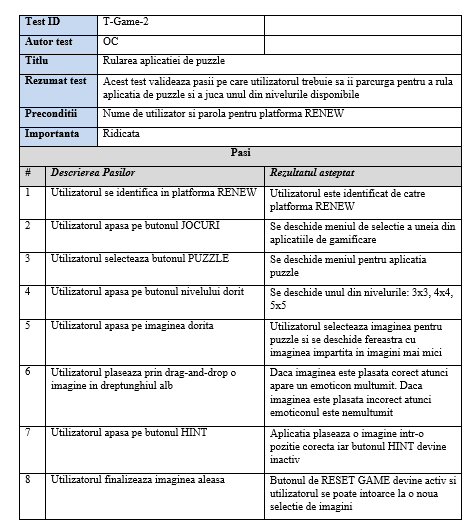
- Activity 3.2: Development of test protocols for the newly developed components: As part of this activity, test protocols were developed for the newly developed components. The goal was to ensure both the robust functioning of the components and their integration into the RENEW platform of the health monitoring component, the smart medicine box, and gamification. Below is an example of testing the puzzle application in the gamification component. After establishing a common template for the testing protocol, protocols were developed for the various functionalities (logging, running, configuration, etc.) of the components.
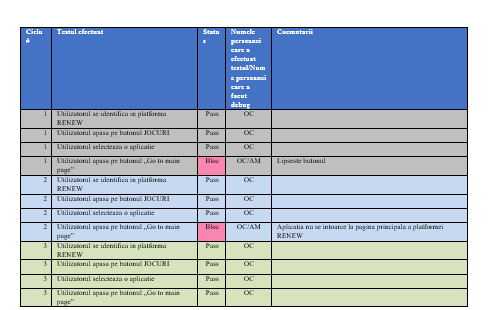
- Activity 3.3: Laboratory testing: As part of this activity, laboratory testing was performed on the functionalities of the components developed according to the protocol developed in activity 3.2. The testing was performed manually and the test cycles were repeated until all the steps defined in the protocol passed the test. The errors observed in the steps that did not pass the test in the first test cycle were corrected and the cycle was repeated. Below we present the testing for the gamification application selection functionality. Three test cycles were performed until all four test steps were performed correctly.
- Activity 3.4: Dissemination via website, social media, 1 scientific publication: During this stage, large-scale dissemination was carried out in collaboration with academic partners in the consortium, using the following dissemination tools:
- Article submitted to an ISI-indexed journal
- Marcin Kolakowski, Vitomir Djaja-Josko, Jerzy Kolakowski, Irina Mocanu, Oana Cramariuc, Ian Perera, Jerzy Gasowski, Karolina Piotrowicz, "Multimodal Dataset of In-Home Physiological and Inertial Measurements from Older Heart Failure Patients," submitted to Scientific Data, Springer Nature, IF: 6.9.
- Presentations
- Mocanu Irina "When data comes to life, artificial intelligence in the service of health", Event organized by the Romanian Academy under the auspices of the International Year of Quantum Science and Technology - 2025, 24.10.2025, Bucharest, Romania.
- Web page and social media
- As part of this activity, the RENEW project website was updated and can be viewed at the following address: http://www.citst.ro/projects/renew. The project is also present on LinkedIn: https://www.linkedin.com/showcase/renew-thcs/.
- Project brochure
- The project brochure was created and sent to all partners to be translated into their local languages.
Phase 4
- Activity 4.1: Contributions to the Development of the Digital Twin Model – Part 1: Within this activity, a methodology for generating a synthetic cohort was developed, together with the initial testing of the underlying algorithms. The controlled generation of a synthetic population eliminates many of the limitations associated with the early stages of model development by enabling the evaluation of a large number of therapeutic scenarios, assessing model robustness, and identifying potential stability issues before introducing real-world clinical data.
The architecture developed within the project enables the simultaneous simulation of multiple therapeutic options and estimates their impact on blood pressure evolution. Unlike conventional approaches that focus solely on predicting physiological values, the RENEW controller compares alternative treatment scenarios and selects the option that provides the best balance between therapeutic effectiveness and the avoidance of over- or under-treatment. In this way, the system functions as a clinical decision support tool rather than an automated prescribing mechanism, preserving the physician's central role in therapeutic decision-making. - Activity 4.2: Design of the Economic Assessment Instruments: The objective of the activity carried out by CITST was to develop the methodological framework required for collecting economic data during the pilot studies conducted in Poland, Slovenia, and Italy. The activity focused on identifying the relevant evaluation perspectives, selecting and developing the required instruments, defining the target respondents and administration time points, and identifying the indicators to be used later in the economic evaluation of the RENEW platform.
Following the analysis, CITST defined the economic perspectives relevant to the RENEW project, identified the data sources available within the pilot studies, and developed the instruments required to collect information that was not already covered by the socio-economic questionnaire. The economic assessment was structured from the perspectives of hypertensive patients, informal caregivers, and healthcare professionals participating in the pilot studies. The healthcare system perspective does not require a separate questionnaire, as it will subsequently be constructed by assigning monetary values to the healthcare services and resources identified through the participant-administered instruments.
The economic evaluation compares the baseline situation, represented by the standard management of hypertension prior to the implementation of RENEW, with the period during which patients are monitored using the platform. The comparison aims to determine whether the introduction of RENEW changes the utilization of outpatient consultations, diagnostic investigations, emergency services, and hospitalizations, as well as patient expenditures, informal caregiver time, and healthcare professional time. These changes are evaluated against the resources required to deliver the RENEW intervention, including tablets, blood pressure monitors, glucometers, weighing scales, wearable devices, technical support, user training, and healthcare professional time. At baseline (T0), information describing the period before the introduction of RENEW is collected. During months M1–M6, data corresponding to the platform utilization period are collected. For relatively frequent events, such as medical consultations and out-of-pocket expenditures, the reference period is 30 days. - Activity 4.3: Intellectual Property Studies – Part 1: To assess the current state of the art and identify existing technological solutions relevant to the development of a Digital Twin for monitoring and managing older patients with hypertension, an analysis of patents available in international patent databases was performed. The search focused on technologies related to digital twins, artificial intelligence, machine learning, continuous blood pressure monitoring, and personalized cardiovascular healthcare management.
The results demonstrate the existence of solutions aimed at predicting physiological parameters, generating personalized recommendations, and dynamically updating patients' digital models. However, the analysis also shows that applications specifically dedicated to older hypertensive patients remain limited, confirming both the innovative character and the development opportunity for an integrated Digital Twin platform targeting this patient population.
The following sections present the results obtained for different keyword searches. One patent was identified as being particularly relevant to the RENEW project because it is among the few that describe a holistic patient Digital Twin integrating, simultaneously, physiological and biochemical data, cognitive and perceptual information, artificial intelligence algorithms, and clinical decision support. This concept closely resembles the architecture envisioned for a Digital Twin dedicated to older hypertensive patients, although the patent itself is not focused on a specific cardiovascular disease. For this reason, it deserves separate consideration within the state-of-the-art analysis. - Activity 4.4: Dissemination through the Project Website, Social Media, and One Scientific Publication: During this reporting period, extensive dissemination activities were carried out in collaboration with the academic partners of the consortium through the following dissemination channels.
- Scientific Publications
- Kolakowski, M.; Djaja-Josko, V.; Kolakowski, J.; Mocanu, I.G.; Cramariuc, O.; Perera, I.; Gąsowski, J.; Piotrowicz, K. Multimodal Dataset of In-Home Physiological and Inertial Measurements from Older Heart Failure Patients. Data 2026, 11, 106. https://doi.org/10.3390/data11050106. Impact Factor: 2.5.
- Conference Presentations
- Presentation of the RENEW project at the XXIX Conference "HIV Horizons", during the plenary session "When the patient changes, the approach changes alike", Kraków, Poland, 20–21 March 2026.
- Karolina Piotrowicz, Vitomir Djaja-Jośko, Irina Mocanu, Giulio Amabili, Vincent Ricordel, Wenda Liu, Tiberiu Seceleanu, Dorin Stanciu, Oana Cramariuc, Jerzy Kołakowski, Barbara Gryglewska, Jerzy Gąsowski. Tackling Hypertension in Older Persons: The Rationale of the "Reshaping Data-Driven Smart Healthcare to Optimize Resources and Personalize Care for Hypertensive Patients through AI and Digital Twin Models" (THCS RENEW Project). Presented at the 23rd IAGG World Congress of Gerontology and Geriatrics – "Ageing Well in a Globalised World", Amsterdam, the Netherlands, 5–8 June 2026.
- Project Website and Social Media
- As part of this activity, the RENEW project website was updated and is available at: http://www.citst.ro/projects/renew. The project also maintains an active presence on LinkedIn: https://www.linkedin.com/showcase/renew-thcs/.
Contact
Address
IT Center for Science and Technology
Radu Beller Street, No. 25, Sect. 1,
Bucharest, ROMANIA